
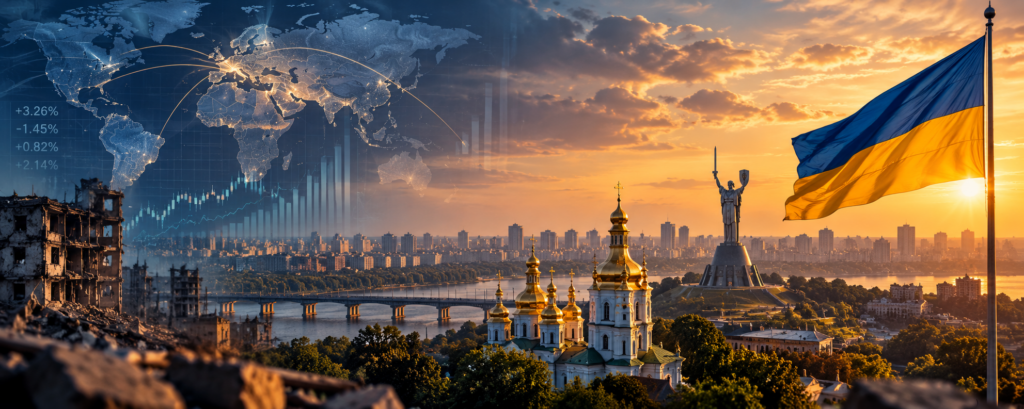
In the twenty-first century, the global economy has become increasingly dependent on political stability and security. At the same time, rising geopolitical tensions across different regions of the world are creating significant economic disruption. In today’s highly interconnected economy, a war in one country rarely remains economically contained within its borders. Its effects can spread through international supply chains, energy and commodity markets, migration flows and financial markets, while also increasing uncertainty and investment risk.
The Energy Shock: Oil, Gas and Coal
Russia’s full-scale invasion of Ukraine, which began on 24 February 2022, caused extensive damage to the country’s productive capacity, energy infrastructure and transport networks. According to a joint assessment by the Government of Ukraine, the World Bank, the European Commission and the United Nations, direct damage had exceeded $195 billion by the end of 2025, while Ukraine’s reconstruction and recovery needs over the following decade were estimated at almost $588 billion.
Russia has historically been one of the world’s major energy suppliers. In 2021, it accounted for approximately 40% of EU natural gas imports, 25% of oil imports and more than 40% of coal imports. Following the outbreak of the war, Russian energy supplies were significantly reduced or discontinued as sanctions and other restrictions reshaped established trade flows.
The immediate impact on energy markets was substantial. In 2022, Brent crude oil traded above $120 per barrel at certain points, while prices at the European TTF gas hub exceeded €300 per MWh. In response, EU countries accelerated efforts to diversify their energy supplies, expand renewable energy capacity and develop infrastructure for liquefied natural gas (LNG) imports.
| Indicator | 2021 | 2022 | 2023 | 2024 | 2025 |
|---|---|---|---|---|---|
| Brent crude oil, $/barrel | 70.86 | 100.93 | 82.49 | 80.52 | 69.14 |
| TTF natural gas, €/MWh | ≈47 | 132 | 41 | 35 | 36 |
| API2 coal, $/tonne | ≈120–122 | ≈290–292 | ≈129 | ≈112.5 | ≈99.5 |
Despite the lower annual averages, energy markets experienced significantly greater volatility in 2022. At various points during the year, Brent crude oil traded above $120 per barrel, TTF natural gas prices reached approximately €340/MWh, while European thermal coal prices exceeded $400 per tonne.
Inflation and the Food Price Shock
The war in Ukraine intensified inflationary pressures that were already present in the global economy during the post-COVID-19 recovery. Disruptions to agricultural production in Ukraine — one of the world’s major exporters of grain, sunflower oil and maize — contributed to food supply pressures across a number of regions, particularly in North Africa and the Middle East. At the same time, rising prices for fuel, fertilisers, transport and logistics added further pressure to inflation.
| Country / Region | 2021 | 2022 | 2023 | 2024 | 2025 |
|---|---|---|---|---|---|
| European Union | 2.9 | 9.2 | 6.4 | 2.6 | 2.5 |
| United States | 4.7 | 8.0 | 4.1 | 2.9 | 2.7 |
| Germany | 3.1 | 6.9 | 5.9 | 2.2 | 2.2 |
| United Kingdom | 2.6 | 9.1 | 7.3 | 2.5 | 3.4 |
| Poland | 5.1 | 14.4 | 11.4 | 3.6 | 3.6 |
| Egypt | 5.2 | 13.9 | 33.9 | 28.3 | 14.1 |
Note: HICP is used for the European Union, while national CPI measures are used for the United States, the United Kingdom and a number of other countries.
Across the EU, annual average inflation rose from 2.9% in 2021 to 9.2% in 2022, before declining to 2.5% by 2025. Eurostat notes that the sharp increase in prices in 2022 reflected, among other factors, the impact of Russia’s invasion of Ukraine, with particularly strong price increases recorded in housing and energy, as well as transport.
The impact, however, varied considerably across countries. In Poland, annual average inflation reached 14.4% in 2022 and remained elevated in 2023, while in the United States it fell from 8.0% in 2022 to 4.1% in 2023. Egypt followed a markedly different trajectory: inflation continued to accelerate after 2022, reaching 33.9% in 2023. The effects of the global price shock therefore cannot be assessed in the same way across advanced and developing economies. Egypt followed a markedly different trajectory: inflation continued to accelerate after 2022, reaching 33.9% in 2023 and remaining substantially more persistent, as reflected in World Bank data. The effects of the global price shock therefore cannot be assessed in the same way across advanced and developing economies.
Disruption to Global Supply Chains
The war created new risks for global trade, including reduced port capacity and restrictions on exports of metals, fertilisers and agricultural products from Ukraine and Russia. At the same time, greater emphasis on economic security and reducing dependence on geopolitically vulnerable regions encouraged multinational companies to reassess their supply chains and reconsider some of the assumptions underlying the traditional model of globalisation.
During the period of severe global logistics disruption, the cost of maritime container transport rose sharply. According to UNCTAD, global container freight rates reached exceptionally high levels during 2021–2022, at certain points rising to four to five times their 2019 levels.
Financial Markets and the Investment Climate
The onset of the full-scale war in Ukraine was accompanied by a significant increase in uncertainty and volatility across global financial markets. Rising geopolitical risk affected asset prices, credit spreads and international capital flows. Major equity indices experienced considerable volatility and declines during the first months of 2022, although these movements reflected several factors operating simultaneously, including high inflation, expectations of tighter monetary policy and uncertainty surrounding the war.
The impact was particularly pronounced in emerging economies. The IMF identified increased pressure on portfolio flows following the outbreak of the war, together with a greater risk of capital outflows as global investor risk sentiment deteriorated.
Although the initial financial-market shock gradually subsided, the war reinforced the importance of geopolitical risk in investment decisions. Political instability, sanctions exposure and supply-chain vulnerability are now more prominent considerations in assessing international investment risk.
Temporary Shock or Structural Transformation?
The economic consequences of the war can be divided into two broad categories: short-term shocks and longer-term structural changes.
The initial response was largely shock-driven. Energy and transport costs rose sharply, inflationary pressures intensified and financial markets became more volatile. As markets adjusted, however, many of these effects began to ease. By 2024–2025, energy prices and inflation across many advanced economies had fallen substantially from their 2022 peaks.
The more important long-term effect lies beneath these headline indicators. Europe has diversified its energy supplies and substantially reduced its dependence on Russian pipeline gas. Global trade flows have shifted, while businesses have become more conscious of geographical concentration and geopolitical exposure within their supply chains. Reliability, resilience and economic security are increasingly considered alongside cost and efficiency when companies and governments make sourcing and investment decisions.
This transformation had already begun during the COVID-19 pandemic, but the war accelerated the shift from a model of globalisation focused primarily on efficiency towards one in which resilience and economic security play a much larger role.
Beyond the Immediate Economic Shock
The war in Ukraine has represented a significant external shock to the global economy, although its economic effects have been far from uniform. Sharp increases in energy and transport costs, rising inflationary pressures and the initial volatility in financial markets were most pronounced during the first years following the full-scale invasion and have since partially subsided.
At the same time, some changes have proved more persistent. The restructuring of the European energy market, the diversification of supply chains, shifts in global trade flows and the growing importance of geopolitical risk demonstrate that the economic consequences of the war extend well beyond short-term macroeconomic indicators.
The economic significance of the war in Ukraine should therefore not be assessed solely through changes in GDP, inflation or commodity prices. Its longer-term impact lies in the growing importance of resilience and economic security as independent considerations in economic decision-making, alongside cost and efficiency.
References
- World Bank Group, Government of Ukraine, European Commission and United Nations (2026).
Updated Ukraine Recovery and Reconstruction Needs Assessment Released. 23 February 2026.
View source → - U.S. Bureau of Labor Statistics (2026).
Year-over-Year Inflation Rate: All Items CPI-U, 2010–2025. - Federal Statistical Office of Germany (Destatis) (2026).
Consumer Price Index: Overall Index and by 12 Divisions. - World Bank (2026).
World Development Indicators: Inflation, Consumer Prices — Egypt, Arab Republic. - Eurostat (2026).
Key Figures on Europe – 2026 Edition. European Commission.
View source → - United Nations Conference on Trade and Development (UNCTAD) (2022).
Review of Maritime Transport 2022. United Nations.
View source → - Board of Governors of the Federal Reserve System (2022).
The Effect of the War in Ukraine on Global Activity and Inflation. FEDS Notes, 27 May 2022.
View source → - Board of Governors of the Federal Reserve System (2022).
Financial Stability Report, May 2022. - International Energy Agency (IEA).
Gas Market Lessons from the 2022–2023 Energy Crisis: Conclusion and Lessons Learned. - International Energy Agency (IEA) (2026).
Gas Market Report, Q1 2026: Executive Summary. - World Bank.
How the War in Ukraine Is Reshaping World Trade and Investment. - European Central Bank (ECB) (2024).
Economic Bulletin, Issue 2/2024. European Central Bank. - International Monetary Fund (IMF) (2025).
IMF Country Report No. 25/78. International Monetary Fund.